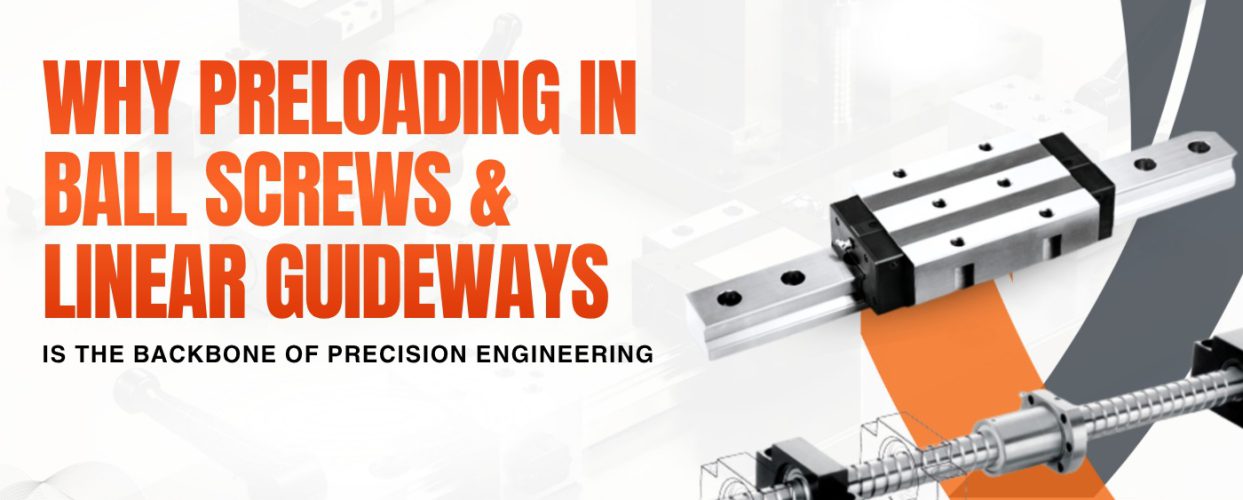
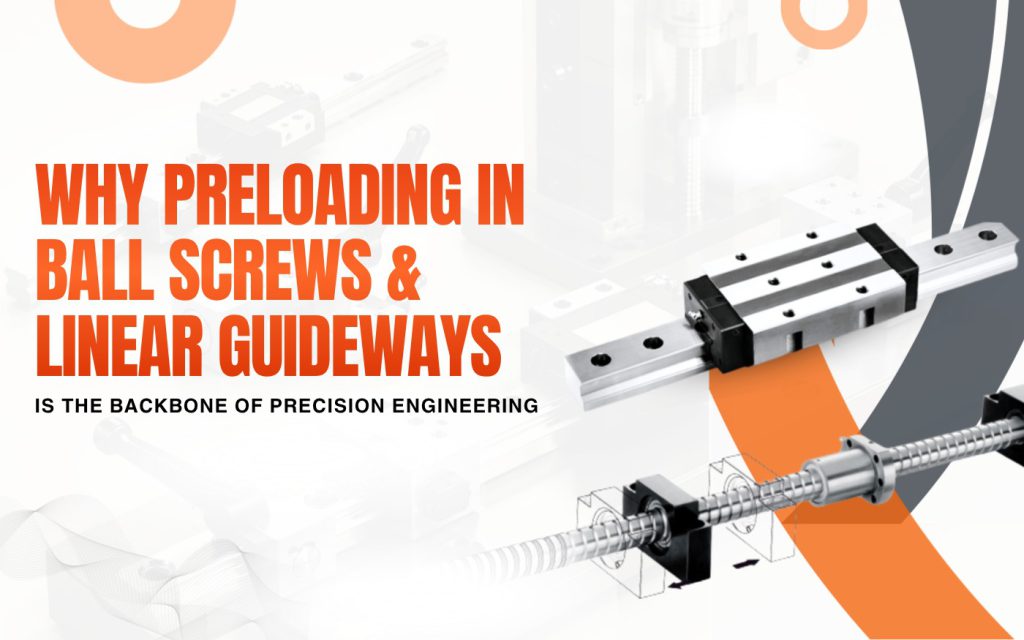
Why Preloading in Ball Screws & Linear Guideways Is the Backbone of Precision Engineering

Why Preloading in Ball Screws & Linear Guideways Is the Backbone of Precision Engineering

super

In modern manufacturing, precision, repeatability, rigidity, and smooth motion are essential for achieving consistent machine performance. CNC machine tools, automation systems, robotics, injection moulding machines, semiconductor equipment, and other precision applications rely on high-quality linear motion components to deliver accurate movement. One important engineering factor behind this performance is preloading in ball screws and linear guideways. Preloading is the controlled elimination of internal clearance between rolling elements and their mating raceways. In simple terms, preload reduces unwanted play within the system, helping improve rigidity, positioning stability, and motion accuracy. For applications where even a small amount of movement or deflection can affect machining quality, the correct ball screw preload and linear guideway preload can make a significant difference.

What Is Preloading in Ball Screws and Linear Guideways?

Preload is an intentional internal load applied to a rolling-element system to reduce or eliminate clearance between its components. In a ball screw, preload is established between the balls, ball nut, and screw raceways. It helps minimize axial play and backlash, allowing rotational movement to be converted into linear movement with greater positional control. In a linear guideway, preload eliminates internal clearance between the rail and carriage. This increases rigidity and helps reduce deflection when an external load or cutting force is applied. The primary purpose of preload is not simply to make a system tighter. It is to achieve the right balance between:
  • Precision
  • Rigidity
  • Backlash control
  • Smooth movement
  • Load capacity
  • Operating speed
  • Friction
  • Heat generation
  • Service life
Therefore, selecting the correct preload is an important part of designing a reliable precision motion system.

Why Is Preloading Important in Precision Engineering?

Precision machines often operate under changing loads, acceleration, deceleration, and frequent directional movements. Any unwanted clearance in the motion system can affect positioning and repeatability. A properly preloaded ball screw and linear guideway system helps minimize these effects.

1. Reduces Backlash

Backlash can result in lost motion when the direction of movement changes. This can become particularly noticeable during bidirectional positioning. Preloading helps reduce internal clearance and therefore minimizes unwanted movement between the mating components. This is particularly important for CNC machines and other applications where accurate positioning is required.

2. Improves Rigidity

Machine components experience external forces during operation. Cutting forces, acceleration forces, and payloads can cause deflection if the motion system does not have sufficient stiffness. Preloading increases the contact between rolling elements and raceways, helping improve system rigidity and reduce deflection. This makes the preloaded linear guideway particularly useful in applications where high stiffness is required.

3. Enhances Positioning and Repeatability

Modern automated machinery may perform thousands or millions of positioning movements. A properly selected preload helps provide consistent contact within the motion system, supporting stable positioning and repeatability over repeated cycles. For CNC machining, automation, and robotic applications, this consistency can contribute to improved process performance.

4. Helps Improve Machining Quality

In machine tools, vibration and deflection can affect surface finish, dimensional accuracy, and tool performance. A suitably preloaded ball screw and linear guideway can provide greater stiffness and smoother motion, helping the machine maintain stable movement during machining operations.

5. Supports Stable Motion Under Load

Linear motion components are often required to carry significant loads while maintaining smooth movement. Preloading helps maintain controlled contact between the rolling elements and raceways, which can improve the stability of the system under operating loads.

Preloading in Ball Screws

There are different methods used to achieve ball screw preload. One commonly used approach involves the use of balls with a controlled size difference to reduce internal clearance between the ball nut and screw raceway. Another approach is the use of a double-nut ball screw arrangement, where two nuts are positioned against each other using a suitable spacer or preload arrangement.

Oversized Ball Preloading

In this method, balls with a slightly larger effective diameter are used to reduce clearance between the screw and nut raceways. The controlled interference between the rolling elements and raceways helps reduce axial play and backlash. This method can provide a practical solution for applications requiring improved positioning accuracy and rigidity.

Double-Nut Preloading

A double-nut arrangement uses two ball nuts positioned relative to each other to create the required preload. This configuration can provide high rigidity and is commonly considered for applications where stiffness, accuracy, and resistance to vibration are important. However, the correct design and installation of a double-nut system are essential to achieve the intended performance.

Preloading in Linear Guideways

Linear guideway preload works on a similar principle. A linear guideway consists of a rail and carriage/block containing rolling elements. Preload is introduced by controlling the relationship between the rolling elements and the raceways. The objective is to eliminate or reduce internal clearance while maintaining smooth and reliable movement. Superslide offers PMI linear guideways in different configurations, including heavy-load, compact, miniature, roller-type, and ball-chain-type solutions for different motion requirements.

How Linear Guideway Preload Improves Performance

A properly selected preload can:
  • Increase rigidity
  • Reduce internal clearance
  • Minimize deflection
  • Improve motion stability
  • Support accurate positioning
  • Improve resistance to external loads
  • Contribute to consistent machine performance
For example, when a cutting tool generates force during CNC machining, insufficient stiffness can result in unwanted deflection. A suitably preloaded linear guideway can help provide the required support for stable movement.

Types of Linear Guideway Preload

Preload should be selected according to the operating requirements of the machine. Generally, linear guideways can be specified with different preload levels, such as:

Light Preload

Light preload is suitable for applications where smooth movement and lower friction are important. It can be considered for systems involving relatively lower loads and applications where excessive stiffness is not required.

Medium Preload

Medium preload provides a balance between rigidity and running characteristics. It can be suitable for applications requiring a combination of positioning performance, stiffness, and smooth movement.

Heavy Preload

Heavy preload is selected when higher rigidity and resistance to deflection are required. It can be useful in demanding machine-tool applications where significant external loads or cutting forces are present. PMI linear guideway specifications include defined preload grades for different series, allowing the preload to be selected according to the application requirements.

Is Higher Preload Always Better?

No. Higher preload does not automatically mean better performance. This is one of the most important considerations when selecting a ball screw or linear guideway. Increasing preload can improve rigidity, but excessive preload can also increase:
  • Friction
  • Driving force
  • Heat generation
  • Energy consumption
  • Rolling-element stress
  • Wear
Superslide’s own technical guidance notes that excessive preload can increase the force required to move a linear guideway carriage, increase heat generation and accelerate wear. Therefore, preload should be selected according to the actual machine requirements rather than simply choosing the highest available preload.

Preload and Operating Speed

High-speed linear motion applications require careful consideration of friction and heat. A heavily preloaded system can generate more friction than a lightly preloaded system. During continuous high-speed operation, this can contribute to temperature rise. Therefore, engineers need to consider:
  • Required positioning accuracy
  • Operating speed
  • External load
  • Acceleration
  • Required rigidity
  • Duty cycle
  • Temperature conditions
  • Expected service life
The objective is to achieve the required performance without unnecessarily increasing friction and heat.

Preload and Thermal Expansion

Temperature is another important factor in precision motion systems. During continuous operation, components can experience thermal expansion. If preload is not correctly selected or the system is improperly installed, temperature changes can influence internal forces and operating characteristics. This is particularly relevant in high-speed ball screw applications and machines operating for extended periods. Proper component selection, mounting accuracy, lubrication, and thermal management should therefore be considered along with preload.

Ball Screw vs Linear Guideway Preloading

Although both systems use preload, their functions are slightly different.
Parameter Ball Screw Preload Linear Guideway Preload
Primary Function Reduce axial clearance and backlash Reduce clearance between rail and carriage
Main Benefit Improved positioning and motion transmission Increased rigidity and reduced deflection
Common Applications CNC axes, automation, precision positioning CNC machines, automation, robotics
Preload Method Oversized balls or double-nut arrangement Controlled rolling-element/raceway interference
Key Consideration Accuracy, backlash, speed and heat Rigidity, load, accuracy and friction
Both components work together in many precision machines. The ball screw controls the conversion of rotary motion into linear movement, while the linear guideway provides guided, rigid linear motion.

Applications of Preloaded Ball Screws and Linear Guideways

Preloaded linear motion components are used across a wide range of industrial applications, including:

CNC Machine Tools

CNC machining requires accurate and repeatable axis movement. Ball screws and linear guideways provide the controlled motion required for machining operations.

Automation Systems

Automated equipment requires repeatable movement across multiple cycles. Properly selected preload can contribute to consistent positioning and motion stability.

Robotics

Robotic systems require controlled linear or rotary positioning. Linear motion components with suitable preload can support accurate movement in demanding applications.

Injection Moulding Machines

Precision movement is important for mould positioning and machine operation. Linear motion systems can provide the required rigidity and controlled movement.

Semiconductor and Precision Equipment

Precision manufacturing environments require controlled movement and repeatability. Selecting appropriate ball screw and linear guideway preload is important for achieving the required motion characteristics.

Machine Tool Applications

Heavy machining operations can generate substantial cutting forces. Higher rigidity and suitable preload can help reduce unwanted movement and deflection.

How to Select the Right Preload

Selecting the correct preload requires an understanding of the complete operating environment. Engineers should evaluate:
  1. Load requirements – Determine the static and dynamic loads acting on the system.
  2. Required accuracy – Identify positioning and repeatability requirements.
  3. Operating speed – Consider the required travel speed and acceleration.
  4. Rigidity requirements – Determine how much deflection the application can tolerate.
  5. Duty cycle – Consider how frequently and how long the system will operate.
  6. Temperature conditions – Account for heat generation and thermal expansion.
  7. Service life – Select preload and components according to the required operating life.
  8. Installation conditions – Ensure mounting surfaces, alignment, lubrication, and installation procedures are appropriate.
The correct preload is therefore an application-specific engineering decision.

Why Choose Superslide for Ball Screws and Linear Guideways?

Superslide & Ballscrews Co. India Pvt. Ltd. specializes in linear motion products and precision ball screws, serving industries that require reliable and accurate motion solutions. The company is the exclusive distributor of PMI Taiwan in India and offers products including ballscrews, linear guideways, ball splines, actuators, rack and pinion systems, linear bearings, precision locknuts, and other linear motion components. Its linear guideway range includes solutions designed for different load, size, motion, and application requirements, while its ballscrew portfolio includes rolled and precision ground ballscrews. For applications where precision, rigidity, smooth motion, and repeatability are important, selecting the correct ball screw and linear guideway combination is essential.

Conclusion

Preloading is much more than simply removing clearance from a mechanical system. It is an important engineering parameter that influences the accuracy, rigidity, stability, friction, and service life of ball screws and linear guideways. The right preload can help reduce backlash, improve rigidity, minimize deflection, and support repeatable machine movement. However, excessive preload can increase friction, heat generation, and wear. For this reason, preload should always be selected according to the application’s load, speed, accuracy, rigidity, and operating conditions. With the right combination of precision ball screws, linear guideways, preload, lubrication, installation, and maintenance, manufacturers can build linear motion systems capable of delivering reliable performance in demanding industrial environments. For assistance in selecting the appropriate ball screw or linear guideway, contact Superslide & Ballscrews Co. India Pvt. Ltd. for application-specific guidance.
Lorem ipsum dolor sit amet, consectetur adipiscing elit. Ut elit tellus, luctus nec ullamcorper mattis, pulvinar dapibus leo.
Read More
How Ball Screws Improve Efficiency in CNC and Automation Equipment

How Ball Screws Improve Efficiency in CNC and Automation Equipment

super

In today’s high-speed manufacturing environment, precision and efficiency are non-negotiable. CNC (Computer Numerical Control) machines and industrial automation systems demand motion components that deliver consistent accuracy, high speed, and long-term reliability.

At the core of these machines lies a critical yet often overlooked component — the ball screw. This precision-engineered device plays a major role in improving machine performance, enhancing productivity, and ensuring repeatable motion control.

What Is a Ball Screw?

A ball screw is a mechanical linear actuator that converts rotary motion into precise linear movement with minimal friction.
It consists of:
Unlike traditional lead screws that rely on sliding friction, ball screws use rolling motion. This significantly reduces friction, resulting in smoother movement, higher efficiency, and reduced energy consumption.

Why Ball Screws Are Essential in CNC Machines

CNC and automation equipment require:
Ball screws meet these requirements by delivering controlled, precise linear motion — which directly impacts cutting accuracy, tool positioning, and overall machine output.

Key Benefits of Ball Screws in Automation Systems

1. Higher Mechanical Efficiency

Ball screws operate with very low friction, often achieving efficiency levels above 90%. This reduces power loss and allows machines to operate faster while consuming less energy.

2. Exceptional Positional Accuracy

Minimal backlash and excellent load distribution ensure highly accurate positioning. This is critical for industries such as automotive manufacturing, aerospace components, and precision tooling.

3. Improved Productivity

Faster response times and smooth motion lead to shorter cycle times in CNC operations, increasing overall production output.

4. Long Service Life

The rolling contact mechanism reduces wear and maintains alignment over time. This results in longer operational life and lower maintenance requirements.

5. Reduced Downtime

Durable construction and reliable motion performance help prevent unexpected breakdowns — especially important in 24/7 automated production environments.

Applications of Ball Screws

Ball screws are widely used in:
In each of these applications, motion precision directly influences product quality and operational efficiency.

Why Choose Superslides for Ball Screws?

At Superslides & Ballscrews Co. India Pvt. Ltd., we supply high-performance PMI ball screws designed to meet demanding industrial standards.
Our advantages include:

Conclusion

Ball screws are not just machine components — they are the backbone of efficient CNC and automation systems. By reducing friction, improving accuracy, and enhancing durability, they play a crucial role in modern manufacturing success.

If you are looking to upgrade your CNC or automation systems with precision-engineered ball screws, Superslides offers trusted solutions tailored to today’s competitive industrial landscape.

Explore our full range of ball screws and linear motion systems to power your manufacturing performance.

Read More
Rack and Pinion Quality: Why the Details Make the Difference

Rack and Pinion Quality: Why the Details Make the Difference

super

In high-precision linear motion systems, rack and pinion quality plays a critical role in accuracy, torque transmission, and long-term performance. While many buyers select racks based on price or a general “Grade 6” label, the real performance lies in the finer technical details—details that often vary from supplier to supplier.

At Superslides, the Authorised Distributor of Apex Dynamics in India, we believe informed decisions lead to better machine performance. This blog explains what Rack Grade 6 (Q6) truly means, how Apex Dynamics defines quality, and how choosing the right rack variant impacts your application.

Understanding Grade 6 (Q6) Rack and Pinion Quality

Grade 6 is the most commonly used quality level in precision rack and pinion drive systems. However, there is no single global definition for Grade 6. Different manufacturers define tolerances differently, which can make comparisons difficult.

The only consistently comparable parameter across suppliers is length deviation per meter. Other factors—such as hardness, surface finish, and heat treatment—can vary significantly.

Ordering a Grade 6 rack alone does not guarantee:

These elements are critical in high-precision and high-load applications.

How Apex Dynamics Defines Grade 6 Quality

Unlike generic standards, Apex Dynamics uses clearly defined, measurable parameters to ensure consistent performance.

Key Accuracy Parameters at Apex Dynamics:

Some suppliers describe pitch deviation as:

These variations make direct comparison difficult. Apex Dynamics eliminates confusion by providing transparent, consistent specifications.

Apex Dynamics Quality 6 Rack and Pinion – Standard Version

Apex Dynamics’ standard Quality 6 rack is engineered for high-precision and high-load applications.

Key Features:

Typical Applications:

Application-Specific Rack Variants from Apex Dynamics

Not every application requires maximum hardness or surface treatment. Apex Dynamics offers optimised variants that maintain accuracy while adapting to specific use cases.

Quality 6M (Milled Sides):

Ideal for: Applications where full side grinding is not essential.

Grade 6A (With Mounting Holes for Linear Guides)


Ideal for: Compact machine designs requiring quick installation.

Quality 6C (Carbon Steel):
Ideal for:

Choosing the Right Rack and Pinion: More Than Just Price

One of the most common mistakes in rack and pinion selection is choosing purely based on cost.
Example Comparison:
  • Standard Grade 6 vs Grade 6C
    • Accuracy is identical
    • Standard Grade 6 can transmit up to four times more torque
This is why understanding accuracy, hardness, torque capacity, and application requirements is essential before selecting a rack.

Why Choose Superslides?


What We Offer:

When you choose Superslides and Apex Dynamics, you’re not just buying components—you’re investing in precision, reliability, and long-term performance.

Final Thoughts

Rack and pinion quality is defined not just by a grade number, but by accuracy standards, heat treatment, feed force, and application suitability. Understanding these details ensures better machine performance, longer service life, and higher return on investment. For expert guidance and genuine Apex Dynamics rack and pinion solutions, Superslides is your trusted partner in India.
Read More
Linear Guideways: Ensuring Smooth, Reliable Linear Motion in Modern Industrial Systems

Linear Guideways: Ensuring Smooth, Reliable Linear Motion in Modern Industrial Systems

super

In today’s precision-driven manufacturing environment, linear guideways are essential components for achieving smooth, accurate, and repeatable linear motion. From CNC machines and automation systems to robotics and packaging equipment, linear guideways enable controlled movement while maintaining rigidity, stability, and long service life.

At Superslides, we supply premium linear guideway solutions designed to meet the demands of modern industrial applications.

What Are Linear Guideways?

A linear guideway is a mechanical system that supports and guides moving machine parts along a fixed path with minimal friction. It consists of a precision-engineered rail and a rolling element carriage that allows smooth motion under load.
Unlike traditional sliding systems, linear guideways:
These advantages make linear guideways a fundamental component in high-performance machinery.

Why Linear Guideways Matter in Industrial Automation

Linear guideways ensure controlled, vibration-free motion, which is critical for maintaining accuracy in automated and high-speed processes. Their design allows machines to operate with higher efficiency, reduced energy consumption, and improved reliability.
Key functions include:

Superslides Linear Guideway Portfolio

Superslides offers a comprehensive range of linear guideways tailored to diverse industrial requirements.
Available Guideway Series:

Each series is engineered with specific load capacity, rigidity, travel accuracy, and vibration control characteristics to suit different applications.

Applications Across Industries

Linear guideways are widely used across multiple industrial sectors due to their adaptability and precision.
Typical Applications:

Application Examples:

Benefits of Premium Linear Guideways

Using high-quality linear guideways delivers several operational advantages:

These benefits contribute directly to higher productivity and reduced total cost of ownership.

Selecting the Right Linear Guideway

Choosing the correct linear guideway is essential for optimal machine performance.
Key Selection Factors:
Superslides provides expert guidance to ensure the selected guideway matches both technical and operational requirements.

Why Partner with Superslides?

Superslides is more than a supplier—we are a technical partner in linear motion solutions.
What Sets Us Apart:

Our expertise helps customers achieve efficient, stable, and precise linear motion in demanding industrial environments.

Conclusion

Linear guideways are a critical element in modern industrial systems, enabling smooth motion, high accuracy, and long-term reliability. Selecting the right guideway improves machine performance, reduces downtime, and enhances overall productivity.

With Superslides, you gain access to advanced linear guideway solutions backed by technical expertise and dependable support—ensuring your machines move with precision and confidence.

Read More
Understanding Ballscrews: Precision Linear Motion for High-Performance Machinery

Understanding Ballscrews: Precision Linear Motion for High-Performance Machinery

super

In today’s advanced manufacturing landscape, precision, repeatability, and durability are non-negotiable. At the heart of many high-performance machines lies a critical linear motion component—the ballscrew. Designed to convert rotational motion into smooth, accurate linear movement, ballscrews play a vital role in ensuring efficiency, accuracy, and long service life across demanding industrial applications.

At Superslides, we offer a comprehensive range of high-quality ballscrews engineered to meet the evolving needs of modern machinery.

What Is a Ballscrew and Why Is It Essential?

A ballscrew is a mechanical device used to convert rotary motion into precise linear motion using recirculating balls between a threaded shaft and nut. Unlike conventional lead screws, ballscrews significantly reduce friction, resulting in:
Because of these advantages, ballscrews are indispensable in systems where precision, speed, and reliability are critical.

Precision and Accuracy at the Core

Ballscrews deliver superior performance by minimising backlash and ensuring consistent motion control. Compared to traditional motion components, they offer:
This makes ballscrews ideal for machines that demand tight tolerances and stable linear motion.

Superslides Ballscrew Product Range

Superslides supplies a wide variety of ballscrew types and configurations to suit diverse industrial applications.
Available Options:

These options allow engineers to select the most suitable ballscrew based on load, speed, accuracy, and operating conditions.

Applications and Industry Relevance

Ballscrews are widely used across multiple industries due to their versatility and performance reliability.
Common Applications:

Industry-Specific Benefits

Why Choose Superslides for Ballscrews?

Superslides stands out as a trusted linear motion partner by combining technical expertise with globally reputed products.
Our Key Strengths :

Our approach ensures customers receive not just components, but complete motion solutions.

Selecting the Right Ballscrew: Key Considerations

Choosing the correct ballscrew is crucial for achieving optimal machine performance.
Factors to Evaluate

Superslides also offers custom end machining, hardened shafts, and ground lead options to ensure seamless integration into your system.

Conclusion

Ballscrews are a foundational element in high-performance linear motion systems. Selecting the right ballscrew directly impacts machine accuracy, efficiency, reliability, and service life. With Superslides, you gain access to world-class ballscrew solutions backed by technical expertise, premium manufacturing standards, and dependable support. Whether your application demands speed, precision, or durability, Superslides helps you move with confidence—Precision in Every Motion.
Read More
What is a Planetary Gearbox?

What is a Planetary Gearbox?

super

A Complete Guide to Working, Benefits, and Applications

A planetary gearbox, also known as an epicyclic gearbox, is a compact, high-performance gear mechanism widely used in industrial and mechanical systems. Renowned for its ability to handle high torque loads and deliver efficient power transmission, a planetary gearbox is commonly found in automation systems, robotics, CNC machines, and heavy-duty equipment. The unique design of the gearbox allows multiple gears to share the load simultaneously, offering better balance, greater strength, and a longer service life compared to traditional gear systems.

Understanding the Planetary Gearbox System

The planetary gearbox consists of three main components: a sun gear at the center, planet gears that revolve around the sun gear, and a ring gear that encloses the planet gears. These planet gears are mounted on a planet carrier, which connects the system and often serves as the output shaft. The term “planetary” comes from the way these gears rotate, just like planets orbiting the sun, offering smooth, synchronized motion.

This clever arrangement enables the transmission of torque through multiple contact points, resulting in a powerful yet compact system. The design also allows different parts of the gearbox to be fixed or rotated independently, providing several gear ratios and movement options. This versatility makes planetary gearboxes suitable for a wide range of speed and torque requirements.

How Does a Planetary Gearbox Work?

The working principle of a planetary gearbox is both efficient and elegant. When power is supplied to the sun gear, it begins to rotate, which in turn drives the planet gears surrounding it. These planet gears are engaged with the internal teeth of the outer ring gear, and as they rotate, they also revolve around the sun gear. The planet carrier holds these planet gears in place and rotates along with them, serving as the output shaft that transfers motion to the application.

Depending on the configuration, different components of the gearbox — the sun gear, ring gear, or planet carrier — can act as the input, output, or fixed element. This flexibility enables planetary gearboxes to deliver either high torque at low speeds or high-speed output, depending on the requirement. The constant engagement of multiple gears also ensures minimal power loss, high efficiency, and smoother operation compared to conventional gearboxes.

Key Advantages of Planetary Gearboxes

One of the most significant advantages of a planetary gearbox Dealer is its ability to produce high torque output within a compact footprint. Since the torque is distributed across multiple planet gears, the gearbox can handle heavier loads without compromising performance. This is especially useful in equipment that demands strong torque and durability in limited space, such as servo motors and industrial machinery.

In addition to torque efficiency, planetary gearboxes offer high mechanical efficiency, often reaching up to 95% or more. This means less energy is lost during gear transmission, which translates to better performance and reduced operational costs. Another standout benefit is the low backlash characteristic. Backlash refers to the slight movement or “play” in the gears when the direction of motion is reversed. In high-precision applications such as robotics, CNC systems, and automation arms, minimal backlash is essential for accurate and repeatable movements.

The durability and longevity of planetary gearboxes are also noteworthy. Due to the load-sharing mechanism among the planet gears and constant gear engagement, wear and tear are significantly reduced. This results in lower maintenance requirements and a longer operational life, even in demanding environments. Lastly, their versatile design makes them adaptable to a wide range of industries and applications.

Industrial Applications of Planetary Gearboxes

Planetary gearboxes are integral to numerous industrial sectors due to their strength, accuracy, and space-saving properties. In the field of industrial automation, they are used in conveyors, automated assembly lines, and packaging machines where high efficiency and reliability are crucial. In robotics, planetary gear motors enable precise, controlled movements of robotic joints and arms, allowing for accurate positioning and smooth motion.

The CNC machinery industry heavily relies on planetary gearboxes for their low backlash and consistent torque output, which is essential for cutting, engraving, and drilling tasks. In the automotive industry, planetary gearboxes are used in automatic transmissions to provide smooth gear shifting and improved driving performance. These gear systems are also common in printing and textile machines, where synchronized operation is necessary for high-quality output. Even in medical equipment, such as surgical robots and imaging systems, planetary gearboxes Dealer play a vital role in delivering accurate, low-noise performance.

Planetary Gearboxes vs. Traditional Gear Systems

When compared to traditional gearboxes like spur or helical gear systems, planetary gearboxes come out ahead in several critical aspects. Traditional gear systems generally operate with a single pair of gears in contact, limiting their load capacity and resulting in more wear and noise over time. In contrast, a planetary gearbox distributes the load among multiple gears, reducing stress on each component and enhancing the overall system’s efficiency and longevity.

Moreover, planetary gearboxes are significantly more compact and powerful, making them ideal for space-constrained environments. They also offer better torque-to-weight ratios, allowing for lightweight installations without compromising performance. The precise alignment and smooth meshing of gears in a planetary gearbox also contribute to quieter operation, which is particularly important in sensitive environments like labs and cleanrooms.

Why Choose Superslides Planetary Gearboxes?

Superslides is a Planetary Gearbox Dealer that offers a wide range of high-quality planetary gearboxes designed to meet the demands of modern industry. Whether you’re building advanced machinery, upgrading your automation setup, or looking for a robust gear solution for your robotics system, Superslides provides gearboxes that are engineered for durability, precision, and high performance.

Each gearbox is crafted using premium-grade materials, precision-cut gears, and state-of-the-art technology to ensure optimal efficiency and long-term reliability. With multiple gear ratio options, customizable torque outputs, and compact design features, Superslides planetary gearboxes can be tailored to suit various industrial needs. The brand is committed to delivering innovative solutions, backed by technical support and expert guidance to help you make the right choice.

Get in Touch with Superslides

Looking for the best planetary gearbox Dealer for your application? Connect with our team at Superslides to explore custom solutions, product specifications, and pricing. Whether you need gearboxes for robotics, automation, or manufacturing equipment, we’re here to help you find the perfect fit.

Read More
Choosing the Right Linear Guide Rails for Your Automation Needs

Choosing the Right Linear Guide Rails for Your Automation Needs

super

In the world of industrial automation, precision and reliability are paramount. Linear guide rails are critical components that ensure smooth, accurate, and efficient motion in various machinery and automated systems. Choosing the right linear guide rails can significantly impact the performance, durability, and cost-effectiveness of your automation setup.

In this blog, we will guide you through the essential factors to consider when selecting linear guide rails for your specific automation needs.

What Are Linear Guide Rails?

Linear guide rails are mechanical components designed to provide precise linear motion. They consist of a rail and a carriage (or slider) with rolling elements like balls or rollers that allow smooth movement with minimal friction. These rails are widely used in CNC machines, robotic arms, packaging machines, and other automation equipment.

Why Choosing the Right Linear Guide Rails Matters

The right linear guide rail enhances:

  • Precision and accuracy — essential for high-quality manufacturing.
  • Load capacity — supports the weight and forces involved.
  • Durability and lifespan — reduces maintenance and replacement costs.
  • Smooth motion ensures operational efficiency.
  • Compatibility with the environment — handles factors like dust, moisture, and temperature.

Key Factors to Consider When Choosing Linear Guide Rails

1. Load Capacity and Dynamic Load Rating

Determine the maximum load your linear guide rail needs to carry. This includes both the static weight and dynamic forces during operation. The dynamic load rating indicates how much load the rail can sustain while maintaining its service life. Selecting a rail with appropriate load capacity prevents premature wear and failure.

2. Accuracy and Precision Requirements

Different automation applications demand varying levels of precision. For tasks like semiconductor manufacturing or high-precision CNC machining, rails with tight tolerances and minimal play are essential. Evaluate the required positioning accuracy before selecting your linear guide.

3. Environmental Conditions

Consider the environment where the linear guide rails will operate. Harsh environments with dust, moisture, or chemicals require corrosion-resistant materials or special coatings. For example, stainless steel rails are ideal for humid or corrosive conditions.

4. Rail Length and Mounting Options

Choose a rail length that fits your machine’s design and motion range. Additionally, check the mounting method compatibility with your equipment—some rails support surface mounting, while others offer embedded or adjustable mounting options.

5. Type of Rolling Elements: Ball Bearing vs Roller Bearing

Linear guides may use ball bearings or roller bearings:

  • Ball Bearing Rails: Provide smooth motion with less friction and are suitable for moderate loads.
  • Roller Bearing Rails: Handle higher loads and shock, but may have slightly more friction.
    Select the type based on your load and motion requirements.

6. Maintenance and Lubrication

Some linear guide rails come with self-lubricating features or sealed designs that minimize maintenance. For applications where downtime must be minimized, consider low-maintenance rails to improve overall productivity.

Why Choose Superslides for Your Linear Guide Rails?

Superslides, we specialize in high-quality linear guide rails and automation components tailored to your industry needs. Our products are manufactured with precision engineering and premium materials to ensure:

  • Superior load capacity and durability.
  • Smooth and accurate motion.
  • Customization options for various sizes and mounting configurations.
  • Corrosion-resistant coatings for harsh environments.
  • Competitive pricing and timely delivery.

Conclusion

Selecting the right linear guide rails is a crucial step in optimizing your automation system’s performance and longevity. By carefully considering load requirements, precision, environment, and maintenance needs, you can ensure your machinery operates smoothly and efficiently.

Explore Superslides’ extensive range of linear guide rails and let our experts help you find the perfect solution for your automation challenges.

Read More
Rack & Pinion

Rack & Pinion

Does it happen that your linear motion system loses its accuracy or breaks down regularly? This failure of LM Guides and Ballscrew can happen because of many reasons which we will be describing here in brief.

Read More
Planetary Gearbox

Planetary Gearbox

Does it happen that your linear motion system loses its accuracy or breaks down regularly? This failure of LM Guides and Ballscrew can happen because of many reasons which we will be describing here in brief.

Read More
Failures in Lm Guides and Ballscrws

Failures in Lm Guides and Ballscrws

Does it happen that your linear motion system loses its accuracy or breaks down regularly? This failure of LM Guides and Ballscrew can happen because of many reasons which we will be describing here in brief. Most basic causes include lack of lubrication, misalignment in assembly, or excessive loading. Some of the most basic failures are as below: 1. WEAR Severe friction can result in serious wear of the rolling…

Read More